
This article was created with the help of a content partner and reviewed by Nutriest’s founders.
Key Takeaways
- There is no ‘best time’ for taking collagen. Rather, it depends on being consistent and taking it as a daily supplement.
- Collagen supplements provide benefits for skin health, joint pain, bone health, gut health, and brittle nails.
- Getting certain benefits from collagen (like workout recovery) may require you to take a supplement beforehand for muscle support, or afterwards for muscle growth.
- The type of collagen (hydrolyzed, type i, type iii) is more important than when you take it.
Table of Contents
- Does timing matter?
- When timing might matter: Pairing collagen with training or rehab
- How collagen is absorbed and why it affects training
- Dose, type and goal: The parameters that determine efficacy
- Conclusion
- Frequently Asked Questions
The collagen timing debate
‘Take collagen in the morning’, ‘No, it’s best at bedtime’, ‘Take it on an empty stomach’, ' Use it only pre-workout’. You’ve probably heard it all, and you still don’t know what to do. Studies are not conclusive about a ‘best time’ to take collagen, and yet there are scenarios when timing can give you an edge - especially in tendon or ligament workout support. We translate the research into simple dosage and timing rules you can use anytime.
Following the science: Does timing matter?

Randomized controlled trials (RCTs) have shown increased skin elasticity and hydration with the daily use of hydrolysed collagen. The focus, however, was not on a set time, but rather that it is taken once a day and that the dosage and type of collagen remain consistent. [1,6]
For bone health ,a 12-month RCT study on post-menopausal women showed that specific collagen peptides (SCP) increased bone mineral density and bone formation when collagen intake increased. The women were given 5g SCP in a glass of water, daily before breakfast. It was shown that collagen peptides are rapidly absorbed in the GI tract, making it readily available for use, but whether this was only due to taking it on an empty stomach was not clear. [2]
For joint pain/osteoarthritis, meta-analysis and RCTs report symptom improvements with collagen peptides or undenatured type ii collagen (UC-II) using once-daily protocols. In knee osteoarthritis, pain was shown to improve by incorporating hydrolyzed collagen peptides in the daily routine of sufferers. However, no emphasis was placed on the timing. [3]
The bottom line for skin, bone, achy joints, and osteoarthritis: The exact time does not influence the outcomes as much as the consistent application of collagen into the daily routine.
Nutriest protocol: 10g High-quality grass-fed bovine collagen powder taken once daily. Alternatively, 10g Wild-caught marine collagen peptide powder taken once daily. Both these supplements are free from additives, 100% natural, and high in glycine, which provides a third of all amino acids in collagen.
When timing might matter: Pairing collagen with training or rehab
One controlled study looked at how 15g of gelatin (made by breaking down the triple-helix structure of collagen with heat) plus Vitamin C, 60 minutes before training, improved collagen levels in the body in order to create stronger connective tissue. Incorporating collagen gave the body what it needed to support muscles and joints. [4]
Why 60 minutes? Because collagen absorption reaches peak levels after an hour after ingestion. If the goal is tendon and cartilage support, or injury prevention, then 10g of collagen with 50mg of Vit C should be taken 45-60 minutes pre-workout. [5] It should be noted that the intake of citrus fruits can also be helpful in improving the uptake of collagen peptides into the body.
How collagen is absorbed and why it affects training
After you ingest hydrolyzed collagen, small di-and tri-peptides appear in the bloodstream. Human studies show peaks at 60-120 minutes after the initial dosage. Concentration then begins to diminish after 4 hours. This window of opportunity for collagen production is why pre-loading before workouts can make sense for recovery and tendon/ligament support. [5]
In ‘What is grass-fed collagen?’ We examine how grass-fed collagen is superior to grain-fed collagen, how collagen is absorbed in the body, and how it is used in different areas to promote healing.
Nutriest grass-fed collagen is rated 4.9/5 on Trustpilot, where quality and value for money were highly rated by reviewers.
Dose, type and goal: The parameters that determine collagen efficacy
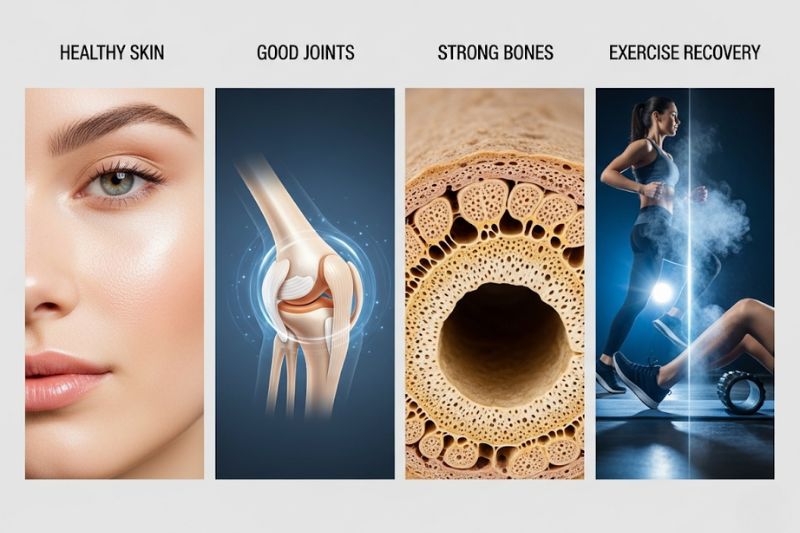
1. Skin (hydration, elasticity, wrinkles)
Typical trial doses: 2.5-5g of hydrolyzed collagen daily, taken for a minimum of 8-12 weeks to see noticeable effects. Can be taken as collagen powder, liquid, or capsule. No prescribed timing. [6]
2. Joint (pain and function)
Hydrolyzed collagen (type ii and type iii collagen): 5-10g in many trials, any time of day with consistent application.
Undenatured type ii collagen: 40mg a day improved knee osteoarthritis vs. placebo. Can be taken any time of day. [3]
3. Bones
Specific collagen peptides, often 5g a day for a minimum of 12 months, can increase mineral bone density - especially in post-menopausal women. [2]
4. Muscles and performance
Up to 10g of collagen can aid connective-tissue remodeling, but whey protein outperforms collagen for muscle protein synthesis and hypertrophy; use whey around workouts. If you use collagen for tendons, take it 1 hour pre-loading, and optionally keep a separate high-quality protein for post-workout.
Conclusion
There are no hard-and-fast science-backed rules about when to take collagen. For most people, you can take it whenever you want - just be consistent. Try to take it at the same time every day so that it becomes part of your usual routine. Match the dosage and form to your goals, and keep expectations realistic by giving it some weeks or months to show its optimal benefits.
Nutriest provides two collagen options that won’t disappoint to help you meet your goals:
Frequently Asked Questions
1. Is it better to take collagen before bed or in the morning?
There is no definitive ‘best time’ to take collagen because it works whether taken in the morning or in the evening. However, consistency is crucial for seeing results. Some have reported a good result when taking it on an empty stomach first thing in the morning, while others like to take it in the evening after a meal.
2. Should I take collagen before or after a workout?
Taking 15-20 of hydrolyzed collagen peptides 30-60 minutes before your workout can provide readily available amino acids for joint and muscle support. Post workout, a complete protein (like whey) can maximize collagen synthesis for muscle growth.
3. How long until I see results from taking collagen?
This depends on what you’re taking it for. For skin benefits, you should notice a difference after 8 weeks, but for joint recover, you will need months, depending on your condition when you begin supplementation.
4. Can I put collagen into beverages?
Yes, hydrolyzed collagen peptide powder is heat-stable, and can be mixed with fruit juice, water, smoothies, or a warm beverage (such as your morning coffee).
5. Do I need to take Vitamin C with collagen?
You don’t need to take Vit C with every dose of collagen; however, for pre-exercise joint and tendon protocols, co-ingesting Vit C has been shown to be effective in research studies. In the body, Vitamin C binds collagen fibres supporting healthy cartilage and connective tissues.
6. Does marine collagen work the same as bovine collagen?
Both can be effective, but they are not equal. Marine collagen contains mostly Type I collagen good for skin, tendons, bones, and ligaments. Bovine collagen contains both Type I and III collagen, which is also important for the gut lining and blood vessel maintenance.
7. Should I take collagen supplements in liquid form or as a powder?
Both forms of collagen are effective. The key factor is whether the collagen is hydrolyzed (broken down into smaller parts) so your body can absorb it. Hydrolyzed collagen reaches the bloodstream as di- and tri-peptides within 1–2 hours after ingestion, making it highly bioavailable.
References:
- Effects of Oral Collagen for Skin Anti-Aging: A Systematic Review and Meta-Analysis, 26 April 2023
- Specific Collagen Peptides Improve Bone Mineral Density and Bone Markers in Postmenopausal Women—A Randomized Controlled Study, 16 Jan 2018
- Analgesic efficacy of collagen peptide in knee osteoarthritis: a meta-analysis of randomized controlled trials, 2023
- Vitamin C–enriched gelatin supplementation before intermittent activity augments collagen synthesis, 16 Nov 2016
- The impact of collagen protein ingestion on musculoskeletal connective tissue remodeling: a narrative review, 4 May 2022
- Oral intake of collagen peptide NS improves hydration, elasticity, desquamation, and wrinkling in human skin: a randomized, double-blinded, placebo-controlled study, 20 February 2023